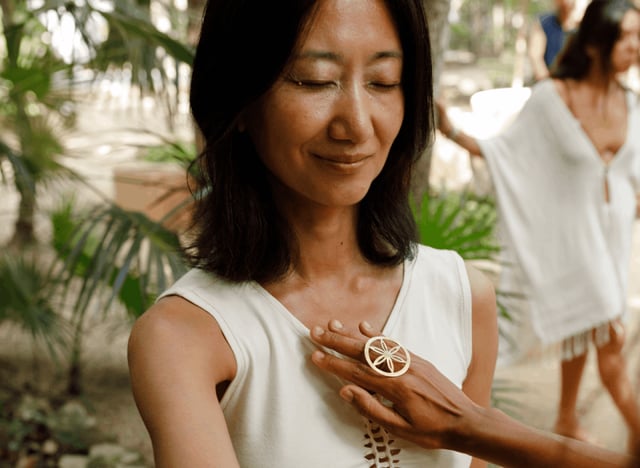
Tantra is a spiritual Indian tradition defined as the practice and belief system with the principle that everything in life is a manifestation of divine energy. The history of Tantra can be traced back to the 8th century AD. The word itself means “to weave”. Tantra works on this energy in humans, appropriating and channelling it on a regular basis. With tantric methods, people can expand their consciousness and the limits of their bodies. “Radical non-duality” which is the “sacredness of everything” is at the heart of tantra. Daily activities we perform like eating and sex are recognised as a part of the Absolute and are accepted as sacred and spiritual in this tradition. Practitioners are on a journey to reach ultimate spiritual pleasure. Tantra promotes the oneness of everything. Whereas different spiritual traditions differentiate what is worldly from what is spiritual, tantric tradition argues such separation can cause alienation. Also, this separation leads to feelings of guilt, low confidence and self-esteem. Tantra unifies every aspect of life into your consciousness, increasing awareness and meaning in everyday life.

The West has long been fascinated by Tantric beliefs and practices. In the 18th century, British colonialists considered Tantra as black magic and were concerned about its anticolonial potential. In the early 20th century, Pierre Bernard introduced America to a new version of New Age mysticism called Neotantra which was popularised over the years with names like Osho, Anand and Muir. Neotantra is the mainstream, eroticised version most people confuse with Tantra today. In the 20th century, free love and guru movements popularised Tantra as an exotic tradition throughout the world. However, the ever-growing popularity of the tantric tradition in the West resulted in some misconceptions and myths about tantric tradition. Some of these misconceptions arise from marketing strategies and some of them are related to the non-conventional teachings of Tantra compared to other spiritual paths. Overall, they lead to confusion and a bad reputation for the practice. Let's take a look at some of the most common misconceptions about tantra:
- Misconception: Tantra is completely about sex
This is probably the most popular myth of them all. Sex has an important place in Tantric tradition because human sexuality is acknowledged as a very powerful energy. However, having sex is not the goal of Tantra, it is a tool to bring awareness and spiritual transformation. Tantric sex is a way to reach divinity. It can help us feel hyper-aware and sensitive to ourselves, others and our energies. With the spiritual, ecstatic intimacy of Tantra our being and how we view reality can be transformed. It is a vessel to the absolute. Tantra is a diverse system with different branches including Tantra Yoga, Tantric Pranayama, Kundalini Yoga, Tantra of relationships, Tantric sexuality, Tantra massage and Kashmiri Shaivism. Sexuality is a part of it but Tantra is so much more than that, it is a way of life. Every aspect of life is embraced in this spiritual path.
- Misconception: I need a partner to be able to practice Tantra
Surprising to many people, this is not true. Tantra requires a deep understanding of your body, and you practice things like Tantric breathing, Tantric meditation and yoga. You don't need a partner to increase your spiritual awareness through Tantra. There are lots of vessels to regulate your energy and consciousness and only a small portion of them requires a partner. You are on an inner journey to connect with the universe and divine energy. You can explore your body and your consciousness through different tantra practices solo. Tantric practices emphasise the role of daily activities and how conscious we are of them. It is how we view the world and it is a journey happening within us.
-
- Misconception: Tantra is a dangerous practice
Tantra is not dark or dangerous in itself, but some of its practices are strong and need care. Most of the fear surrounding tantra is related to the mystique of kundalini which is the fundamental power located in the spine. Since it is such a strong energy, awakening it requires precaution and the elimination of impurities or imbalances beforehand. Kundalini and breath practices can bring up strong physical and emotional reactions, even with a good teacher. Please talk to your doctor first if you are under 18, pregnant, or have epilepsy, heart disease, uncontrolled high blood pressure, glaucoma, recent major surgery, a severe mental health condition or a recent psychiatric crisis; and do not practise after alcohol or drugs in the last 24 hours or during a 48-hour fast. More in our breathwork safety guide. Just like any other practice, working with trained practitioners and giving an effort to understand the basis is required for safe and effective results.

-
- Misconception: Tantra is black magic and practices weird ritualism
Tantric tradition has stories about paranormal experiences and the abilities of masters. It can involve crystals for healing purposes and rituals such as meditation to facilitate connection with your inner self and promote healing. However, it is a spiritual practice whose main goal is to reach self-realisation and a deep understanding of reality. It is neither black magic nor a cult or coven-like tradition. This misconception about magic can be associated with Tantra’s unconventional and groundbreaking stance among other practices since it is a “non-ascetic and non-priestly” path.
Misconception: Tantra is inaccessible and complicated
The tantric tradition is indeed a large field filled with terminology, concepts, texts, philosophies and practices. It can be confusing and takes some time, effort and patience to get a grip. However, some of the most fundamental principles of Tantra are very simple and can be applied at all times as a part of our daily lives. Each of us has divine energy within and each of us has the power to get in touch with it. Each of us can begin with these simple principles.
Joining a course or following a teacher can help you in your journey immensely. The coursework and practices are created to help you learn gradually with your own momentum without getting lost. A trained teacher makes the path clearer and safer. Tell them about any health or mental health condition before you start.
-
- Misconception: Tantra is all about pleasure, fun and following one’s own desires
This misconception is mostly the result of marketing as some teachers promote this tradition as the easy or fast path. However, there is no easy path to spiritual awakening; it takes discipline and a lot of inner work and can take years of study. Tantra is an extremely rewarding path to choose for self-discovery and connection with the universe. Your hard work will pay off as the many doors to wisdom, pleasure and joy open up for you along the way. You get in touch with your mind and body and also with the divine power. Tantra uses pleasure in daily activities which other traditions can identify as “worldly” as a tool to connect with what is divine. Thus there is less guilt or deprivation which makes this entire system joyful. However one would be mistaken to assume momentary pleasures are the goal of Tantra, instead, they are a means to an end.
Our Holosomatic® Method Training draws on Kashmir Shaivism, non-dual Tantra, Tibetan Tantric Buddhism and Taoist practice, alongside modern psychology.
References
3 Prevalent Myths About Tantra: Ecstatic Living. Ecstatic Living® Institute - Discover Everyday Ecstasy And Tantric Love. (n.d.). https://www.ecstaticliving.com/blog/3-myths-about-tantric-intimacy.
Berzin, D. A. (2021, March 1). Common Misunderstandings about Tantra. - Study Buddhism. https://studybuddhism.com/en/tibetan-buddhism/tantra/buddhist-tantra/common-misunderstandings-about-tantra.
Guardian News and Media. (2020, September 21). The art of tantra: is there more to it than marathon sex and massages? The Guardian. https://www.theguardian.com/artanddesign/2020/sep/21/tantra-british-museum-marathon-sex-massages.
The Naked Truth About Tantra – Myths Debunked. Centre of Excellence. (2017, September 4). https://www.centreofexcellence.com/naked-truth-tantra-myths-debunked/.
Tantra & Its Misconceptions. Tantra Nectar. (2020, July 18). https://tantranectar.com/tantra-its-misconceptions/.
Tantra Is Not Sex! Somananda Tantra School. (2020, October 19). https://somananda.org/blog/tantra-is-not-sex/.
Tantra misconceptions. AUM Tantra Yoga. (2020, November 3). https://aumtantrayoga.com/tantra-misconceptions/.
Zutshi, V. (2019, March 26). How the ancient Indian tradition of Tantra became all about sex and orgasms in the US. Scroll.in. https://scroll.in/magazine/916420/how-the-ancient-indian-tradition-of-tantra-became-all-about-sex-and-orgasms-in-the-us.
Explore the Holosomatic® Method Training: one online training in breathwork, bodywork, energy and manifestation, in three levels. It starts on 1 February 2027, with Level 1 from €1,499.
Related reading: What is the Holosomatic® Method? · InnerCamp Membership