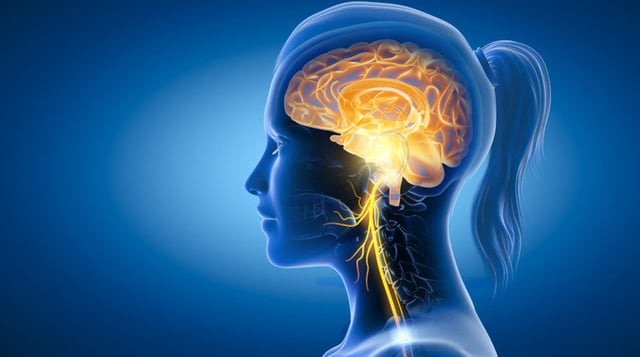
A brainwave is a measurable and recognizable pattern of electrical impulses in our brains. Any emotion, thought and behaviour is the result of the communication between neurons, which produces synchronized electrical pulses.
Brainwaves are measured in cycles per second or hertz (Hz) and are called delta, theta, alpha, beta and gamma. The latter are not thoroughly understood in neuroscience yet, but we know that their rhythms modulate perception and consciousness.
When the brain is aroused and actively engaged in mental activities, it generates beta waves. These beta waves are of relatively low amplitude and are the second-fastest of the different types. They tend to dominate most of our everyday lives.
Alpha brainwaves are slow in frequency and high in amplitude, occurring during states of non-arousal. Frequency ranges from about eight to twelve cycles per second. When closing the eyes and picturing something peaceful, there is an increase in alpha brainwaves. They have been associated with the storage and retrieval of information (Rodriguez-Larios, Faber, Achermann, Tei & Alaerts, 2020). Theta brainwaves are slower in frequency and higher in amplitude than alpha brainwaves. Frequency ranges from five to eight cycles per second. When someone is daydreaming or does a task automatically, they are in a theta brainwave state. These waves are associated with drowsy, dreamlike and deeply absorbed states. Theta brainwave states have been associated with the manipulation of information (Rodriguez-Larios et. al, 2020). Delta waves are even slower in frequency and greater in amplitude than alpha and theta waves. Delta wave frequency ranges from one to four cycles per second, with the lowest frequencies occurring in deep sleep.

Mindful breathing, which consists of paying attention to the sensation of the breath coming in and out of the body, can change our brainwaves. Some studies have linked relaxed, focused breathing with more alpha activity. In one study, people who trained their alpha brainwaves with neurofeedback (a machine-guided training) reported less anxiety (Hardt, 2012). According to Rodriguez-Larios et al. (2020), from a cognitive perspective, breathwork practices require retention and manipulation of information to gain this state of thoughtless awareness. A review reported increased alpha and theta activity during meditation in some studies (Lomas, Ivtzan & Fu, 2015). The six-week study by Ziegler et al. (2019) involved young adults new to meditation using an app, not experienced meditators. No wonder that the original Rebirthing Center in San Francisco was called “Theta House”. Acceleration of alpha peak frequency is induced by effortful cognitive tasks (such as when initially engaging in breathwork) and theta peak occurs when such cognitive tasks are complete or effortless (Mierau, Klimesch & Lefebvre, 2017). In regard to delta waves, a study (by Jaiswal, Tsai, Juan, Muggleton, & Liang, 2019) found that those who were skilled in mindfulness had lower delta oscillations during task completion than the other participants present. This indicates an increase in attentiveness from practising meditative breathwork, aligning with the concept of being in the present moment.
In addition, a study by Rodriguez-Larios et. al, (2020) found that compared to being in a state of rest, experienced meditators have reduced retrieval, retention and manipulation of information during a meditative state. This is in line with the common experience of reduced mind wandering and heightened sense of thought awareness during meditation (Brandmeyer & Delorme 2016), reflected in an interplay between alpha and theta waves. A review by Tang, Hölzel and Posner (2015) suggests that meditation may be linked with changes in the anterior cingulate cortex (ACC). The ACC enables executive attention and control and is part of a network facilitating cognitive processing. In other words, meditation research suggests that training attention may strengthen it over time.
Trust in yourself. You hold the key to your own transformation. 🌟
Want to practise this at home? Try the 21-Day Holosomatic® Activation.
Discover the incredible potential of your breath. Release stress, embrace tranquillity, and step into a more empowered you.
References
Brandmeyer, T. & Delorme, A. (2016). Reduced mind wandering in experienced meditators and associated EEG correlates. Exp. Brain Res.
Hardt, James, “Alpha Brain-Wave Neurofeedback Training Reduces Psychopathology in a Cohort of Male and Female Canadian Aboriginals”, 2012, National Library of Medicine
Jaiswal, S., Tsai, S. Y., Juan, C. H., Muggleton, N. G., & Liang, W. K. (2019). Low delta and high alpha power are associated with better conflict control and working memory in high mindfulness, low anxiety individuals. Social cognitive and affective neuroscience, 14(6), 645-655.
Lomas, T., Ivtzan, I., & Fu, C. H. (2015). A systematic review of the neurophysiology of mindfulness on EEG oscillations. Neuroscience & Biobehavioral Reviews, 57, 401-410.
Mierau, A., Klimesch, W., & Lefebvre, J. (2017). State-dependent alpha peak frequency shifts: Experimental evidence, potential mechanisms and functional implications. Neuroscience, 360, 146-154.
Rodriguez-Larios, J., Faber, P., Achermann, P. et al. (2020). From thoughtless awareness to effortful cognition: alpha - theta cross-frequency dynamics in experienced meditators during meditation, rest and arithmetic. Sci Rep 10, 5419
Tang, Y. Y., Hölzel, B. K., & Posner, M. I. (2015). The neuroscience of mindfulness meditation. Nature Reviews Neuroscience, 16(4), 213-225.
Ziegler, D.A., Simon, A.J., Gallen, C.L. et al. (2019). Closed-loop digital meditation improves sustained attention in young adults. Nature Human Behaviour 3, 746–757
Explore the Holosomatic® Method Training: one online training in breathwork, bodywork, energy and manifestation, in three levels. It starts on 1 February 2027, with Level 1 from €1,499.
Related reading: Breathwork safety